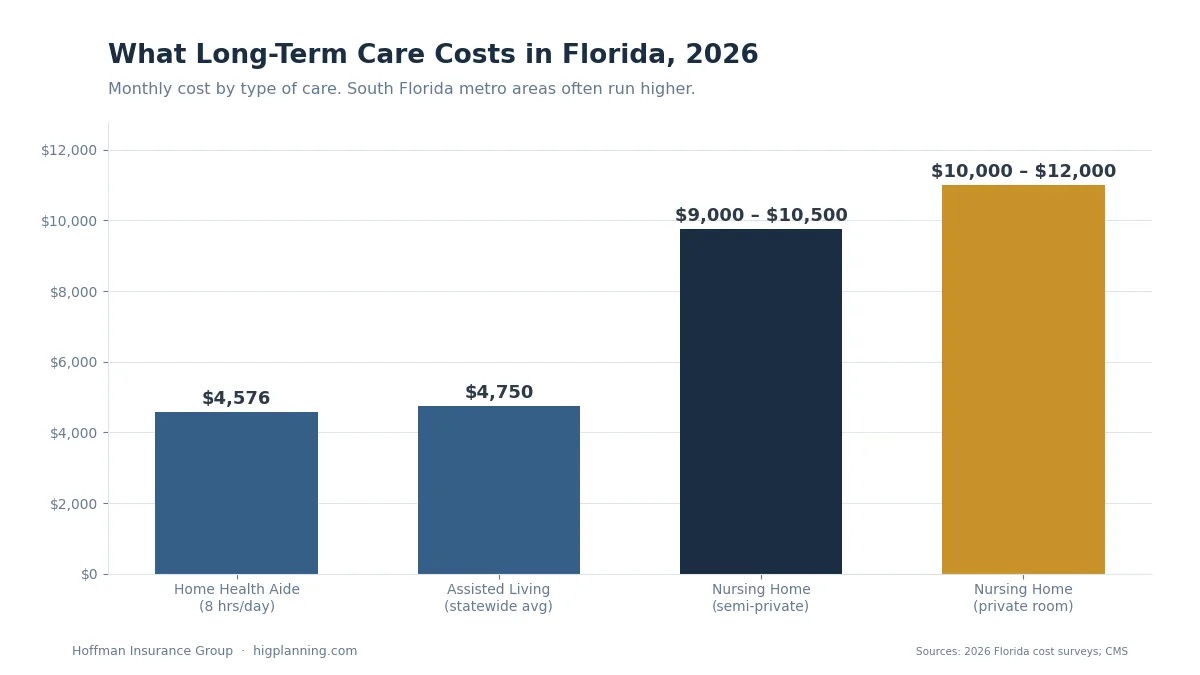
Florida is the most popular retirement destination in the country. Long-term care costs here are significant, and South Florida's coastal markets often run above statewide averages. More than 21% of Florida's population is 65 or older, demand for care is high and rising, and that demographic reality keeps prices elevated across the region.
Most people know long-term care is expensive. Most people do not know how expensive, or what the money actually has to come from, or what Medicare will and will not pay. This guide answers all three questions with current 2026 numbers.
What Long-Term Care Actually Costs in Florida in 2026
There are three main types of care, and the costs vary considerably between them. Understanding the difference matters because most people who need long-term care do not go directly to a nursing home. They often start with home care or assisted living, and only move to skilled nursing if their needs escalate.
| Type of Care | Monthly Cost (Florida Avg) | Annual Cost | Notes |
|---|---|---|---|
| Nursing Home (semi-private) | $9,048 to $10,500 | $108,576 to $126,000 | South Florida metro areas often run $11,000 to $12,000+ |
| Nursing Home (private room) | $9,963 to $11,905 | $119,556 to $142,860 | Some premium facilities in coastal South Florida markets can exceed $150,000/year |
| Assisted Living Facility | $4,385 to $5,600 | $52,620 to $67,200 | Range from $4,000 rural to $6,800 in premium South Florida |
| Home Health Aide (8 hrs/day) | $4,576 | $54,912 | Based on $26/hr, 8 hrs/day, 22 days/month |
| Home Health Aide (full-time, 24 hrs) | $13,728+ | $164,736+ | Around-the-clock home care often exceeds nursing home costs |
| Average 3-Year Nursing Home Stay | $324,000 to $432,000 total | A multi-year stay can quickly consume substantial retirement savings without a plan in place | |
Costs have risen 3% to 5% per year in recent years and are projected to continue increasing. Within two years, private room nursing home costs in Florida are expected to exceed $150,000 annually at current trends, according to legal and eldercare planning resources tracking 2026 costs.
The South Florida Premium
The numbers above are statewide averages. In Broward County, Miami-Dade, Palm Beach County, and the Keys, costs run above those averages. Proximity to major medical centers, higher facility staffing costs, real estate costs, and the general cost of living in South Florida all push care costs higher than the rural interior of the state.
If you are planning for care in Fort Lauderdale, Boca Raton, Miami, or West Palm Beach, assume costs at or above the higher end of each range. Planning to the state average and then receiving care in a South Florida facility produces a meaningful shortfall.
What Medicare Actually Covers
This is the most commonly misunderstood aspect of long-term care planning. Many people believe Medicare will cover nursing home care. It does not, with one narrow exception.
Medicare covers up to 100 days of skilled nursing facility care following a qualifying hospital stay of at least three days. The first 20 days are fully covered. Days 21 through 100 require a daily coinsurance amount of $217.00 in 2026, per the CMS 2026 Medicare Parts A and B Premiums and Deductibles fact sheet. After day 100, Medicare coverage ends completely.
Medicare does not cover custodial care. Custodial care is care that helps with activities of daily living such as bathing, dressing, eating, and moving from bed to chair. This is the type of care that most nursing home residents actually need. It is the type of care that costs $10,000 per month. Medicare does not pay for it.
A typical scenario: A 78-year-old has a fall, goes to the hospital for four days, then enters a skilled nursing facility for rehabilitation. Medicare covers the first 20 days fully. Days 21 through 100, the family pays $217.00 per day in coinsurance. After day 100, Medicare stops entirely.
If the person recovers and goes home, the experience is manageable. If the injury results in permanent loss of function and the person needs ongoing custodial care, the family is now paying the full nursing home rate from day 101 onward, with no Medicare coverage at all. That is when the financial reality of not having a plan becomes difficult to manage.
What Medicaid Covers and What It Costs You to Qualify
Medicaid is a genuine safety net for long-term care. It pays for nursing home care and, through Florida's Statewide Medicaid Managed Care Long-Term Care program, for assisted living and home-based care as well. For people who qualify, it covers care costs indefinitely.
The catch is the qualification criteria. In Florida in 2026, to qualify for Medicaid long-term care coverage as an individual, your monthly income must be below $2,982 and your assets must be below $2,000. If you are married and your spouse is healthy, the community spouse can keep up to $162,660 in assets, the family home (subject to a $713,000 equity cap), one vehicle, and certain personal property.
A retired South Florida couple has $600,000 in retirement accounts, a paid-off home worth $450,000, and $80,000 in savings. The husband needs nursing home care.
The wife can keep the home, one vehicle, and up to $162,660 in combined assets. Everything above that threshold must generally be spent on the husband's care before Medicaid begins paying.
In this scenario, $517,340 of the couple's assets must be spent on care first. At $10,500 per month, that is roughly 49 months of nursing home costs before Medicaid becomes available. That is more than four years of private-pay care, using a large portion of their liquid savings before Medicaid becomes available.
Medicaid planning with an elder law attorney can legally protect some assets through irrevocable trusts, Lady Bird deeds, and other strategies. These strategies work best when implemented years before care is needed. Crisis planning, done after a person is already in a facility, has far fewer options.
The scenario above is a simplified illustration. Medicaid eligibility and spend-down rules are technical and vary based on income sources, exempt assets, prior transfers, trust structures, home equity, and spousal planning strategies. Families should work with a qualified elder law attorney before moving assets or relying on Medicaid as a primary plan. HIG does not provide Medicaid planning or legal advice.
Five Ways to Pay for Long-Term Care in Florida
The Private LTC Insurance Market in 2026
The standalone long-term care insurance market has changed significantly over the past two decades. Where more than 100 carriers were selling policies in 2002, the market contracted sharply as carriers mispriced early policies, faced higher-than-expected claims, and lost money. By the early 2020s, roughly a dozen companies were actively selling meaningful standalone LTC coverage.
The picture in 2026 is modestly better. Some carriers that had exited filed new products in 2025, according to Milliman's annual LTC claims projection. Hybrid products have grown significantly. According to a joint LIMRA and EY survey published in January 2026, hybrid life and LTC combination products are now the leading private LTC insurance solution, with strong and growing market momentum.
Standalone Traditional LTC Insurance
A standalone LTC policy provides the most benefit per premium dollar among the three options. Premiums are tax-deductible in some circumstances. The policy pays a daily or monthly benefit when you meet the criteria for needing care, typically being unable to perform two or more activities of daily living.
The concern most people raise with standalone LTC is the use-it-or-lose-it nature of the coverage. If you pay premiums for 30 years and never need care, you receive nothing. Premiums can also increase over time, which has been a source of significant frustration for policyholders who bought early policies priced too low.
Modern standalone policies are priced more conservatively than early-generation policies. Carrier competitiveness for standalone LTC varies significantly by age, health, state, and benefit design. As an independent broker, HIG compares available options across carriers rather than defaulting to one company.
Hybrid Life/LTC Insurance
A hybrid policy combines a life insurance or annuity base with LTC acceleration benefits. If you need care, the policy pays out LTC benefits. If you never need care, your heirs receive a death benefit. There is no use-it-or-lose-it concern.
The trade-off is that hybrid policies typically provide less LTC benefit per premium dollar than standalone policies. But for people who want guaranteed value regardless of whether care is needed, hybrid products solve the objection that has kept many people from buying standalone coverage.
Carrier competitiveness for hybrid products changes with underwriting guidelines, pricing updates, and available riders. HIG compares hybrid options across multiple carriers for each client's specific age, health profile, and coverage goals.
Annuity-Based LTC Plans
An annuity-based LTC plan converts existing savings into a guaranteed care fund. These products can sometimes be structured without new medical underwriting, which makes them relevant for people whose health status has changed and who might not qualify for traditional LTC underwriting. They are a way to reposition existing assets rather than making new premium payments.
The ideal window for purchasing LTC insurance is between ages 50 and 65. Before 50, you are paying premiums for a long time before you are likely to use the coverage. After 65, premiums increase significantly and health conditions that have developed may affect your ability to qualify at all.
For Florida residents specifically, buying during this window also locks in coverage before costs in South Florida markets rise further. A policy issued at 58 with today's rates and today's health profile is a materially different financial outcome than a policy issued at 68 after a health event.
How LTC Insurance Actually Works When You Need It
People sometimes assume LTC insurance is difficult to use. The claims process for a quality policy is more straightforward than many expect.
To qualify for benefits, you typically must be unable to perform two or more activities of daily living without assistance, or have a cognitive impairment such as dementia. Activities of daily living include bathing, dressing, eating, transferring from bed to chair, toileting, and maintaining continence.
Once you qualify, the policy pays a daily or monthly benefit directly to you. You decide how to use it. Most policies today cover home care, assisted living, and nursing home care, giving you flexibility about where you receive care.
Most policies have an elimination period, typically 30 to 90 days, during which you pay for care yourself before the policy begins paying. Think of it as a deductible measured in days rather than dollars.
The Florida-Specific Planning Considerations
A few things about Florida's environment that affect LTC planning specifically.
The Medicaid waitlist is real. Florida's Statewide Medicaid Managed Care Long-Term Care program, which covers home-based and assisted living care, has a waitlist. People who qualify financially and medically may wait months before benefits begin. This is a meaningful gap for families relying on Medicaid as their primary plan.
Florida has a Long-Term Care Partnership Program. This is a state-federal partnership that allows people who purchase qualifying LTC insurance policies to protect additional assets equal to the benefits the policy pays out before Medicaid begins. It is a meaningful incentive for Florida residents to purchase private coverage.
Florida is a no-income-tax state. For high-income retirees, the tax efficiency of LTC insurance premiums and benefits is somewhat different than in states with income tax. A Florida-based financial planner or advisor can help with the specifics.
A Realistic Planning Timeline
Long-term care planning is not a one-day decision. But it works best when it follows a clear sequence.
In your 50s: Get a real cost estimate for care in your area. Review your current financial picture. Talk to an LTC specialist about what coverage would cost at your current age and health status. Buy if the numbers make sense. The window is open and options are plentiful.
In your early 60s: If you do not have coverage, this is the last comfortable window. Premiums are higher but not prohibitive. Some health conditions may now affect underwriting. Get quotes now rather than after another health event narrows your options further.
In your late 60s and 70s: If you do not have traditional LTC coverage, explore annuity-based options and review your Medicaid planning picture with an elder law attorney. Options are more limited but not zero.
Before any of this: Have an honest conversation with your family about what you would want if you needed care. Who would provide it? Where would you receive it? How would it be paid for? These conversations are uncomfortable, but they are the difference between making decisions thoughtfully and making them under pressure.