For four decades, bonds did what investors expected. They generated income. They rose when stocks fell. They provided the stability that made a 60/40 portfolio work.
2022 ended that assumption.
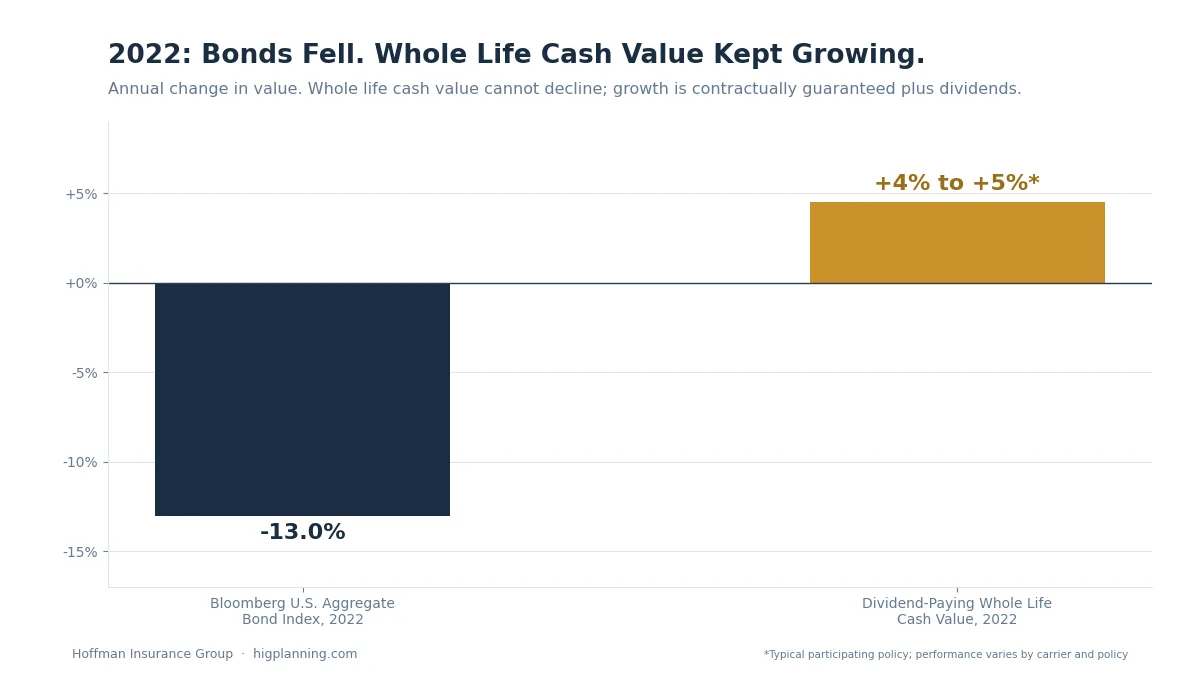
When the Federal Reserve raised interest rates at the fastest pace in forty years, the Bloomberg U.S. Aggregate Bond Index fell 13.01%. Investors holding bonds for stability absorbed losses comparable to a moderate stock market correction, at the same time equities were declining. A 60/40 portfolio fell roughly 16% that year.
Bonds are not bad assets. But they carry interest rate risk that many investors had underestimated. That recognition has pushed a growing number of investors to ask how much of their fixed income allocation actually needs to sit in a traditional bond portfolio.
One answer gaining traction: cash value whole life insurance from mutual insurance companies.
What You Are Actually Comparing
A bond portfolio, whether held directly or through a fund like the iShares Core U.S. Aggregate Bond ETF, is a collection of debt instruments issued by governments and corporations. You are lending money in exchange for interest payments and the return of principal at maturity. Your returns depend on the interest rate environment, the credit quality of the issuers, and how long the bonds you hold take to mature.
Cash value whole life insurance from a mutual company works differently. When you pay premiums into a participating whole life policy, the insurance company invests those funds through its general account, primarily in long-term investment-grade bonds and commercial mortgages. At the end of each year, the carrier credits your cash value with a guaranteed minimum return plus an annual dividend based on actual investment performance, mortality experience, and operating efficiency.
Mutual insurance companies, like MassMutual, Penn Mutual, Guardian, and New York Life, are owned by their policyholders rather than outside shareholders. Profits are distributed back to policyholders as dividends. That ownership structure creates different incentives than a publicly traded insurer, and it is the source of the consistent dividend-paying history that makes these policies useful as a financial planning tool.
The Return Comparison
Bond Portfolio Returns: The Real Record
The Bloomberg U.S. Aggregate Bond Index is the standard benchmark for investment-grade bond performance. Here is its actual annual return record for the past decade:
| Year | Bloomberg U.S. Aggregate Return | Context |
|---|---|---|
| 2015 | 0.48% | Rising rate environment |
| 2016 | 2.41% | Post-election rate spike |
| 2017 | 3.55% | Stable rates |
| 2018 | 0.10% | Fed tightening begins |
| 2019 | 8.46% | Rate reversal, strong returns |
| 2020 | 7.48% | COVID flight to safety |
| 2021 | -1.77% | Inflation concerns emerge |
| 2022 | -13.01% | Fastest rate hike cycle in 40 years |
| 2023 | 5.65% | Recovery as rates stabilize |
| 2024 | 1.25% | Rates remain elevated |
| 2025 | 7.30% | Rate easing cycle begins |
| 10-Year Average | ~2.0% | Includes 2022 losses |
The ten-year average masks a critical reality: bond returns are highly uneven, and the losses in a single bad year can take multiple good years to recover. A 13% loss in 2022 required the 5.65% gain in 2023 and the 7.30% gain in 2025 just to get back to the starting point. That is before accounting for taxes on interest earned in the positive years.
Whole Life Cash Value: What Mutual Companies Are Actually Paying
Major mutual insurance companies declare annual dividend rates based on their investment returns, mortality experience, and operating costs. These dividends are paid on top of the guaranteed cash value growth in the policy. Here is where the leading carriers stand as of 2026:
The dividend rate is the interest component of the annual dividend, the portion driven by investment portfolio performance. The overall policy return, combined with guaranteed cash value growth, typically runs 4 to 5 percent in later policy years on a tax-equivalent basis. In years 11 through 20, well-structured policies from top carriers have historically delivered 4.7 to 4.9 percent annually.
These returns did not go negative in 2022. While bond investors absorbed a 13% loss, whole life policyholders received their regular dividend credit. Cash value grew. Modestly, but it grew.
The Tax Comparison
Raw return numbers do not tell the full story, particularly for high-income earners. The tax treatment of bond income versus whole life cash value growth is significantly different, and that difference compounds over time.
Bond interest is taxed as ordinary income in the year it is received. For a professional in the 37% federal bracket, a 4.5% bond yield becomes approximately 2.84% after federal taxes. Add state income taxes, and the after-tax yield shrinks further. Florida residents pay no state income tax, an advantage that makes the after-tax comparison here somewhat kinder than it is in high-tax states.
Whole life cash value grows tax-deferred. You pay no taxes on the growth each year. When you access the cash value through a policy loan, which is the standard method, the loan is not a taxable event. You are borrowing against the policy's collateral, not withdrawing taxable funds.
The tax equivalent yield concept is useful here. A 4.5% tax-free return on whole life cash value requires a pre-tax bond yield of approximately 7.1% for a 37% bracket investor to match it. In the current environment, no investment-grade bond portfolio is delivering 7.1%.
The Non-Correlation Argument
The most compelling case for whole life cash value in a portfolio is not the return. It is the behavior during stress.
Traditional portfolio theory holds that bonds rise when stocks fall. For decades this was largely true. The 2022 environment showed it does not hold when the source of market stress is inflation and rising interest rates rather than recession. Bonds and equities fell together.
Whole life cash value operates on a different mechanism than bond fund prices. The insurance company holds bonds to maturity in its general account. It does not mark them to market the way a bond fund does. When interest rates rise and the market value of those bonds falls, that loss is never passed to policyholders. The carrier absorbs the duration risk. The policyholder receives the annual dividend credit and moves on.
Research on this point has been published in the Journal of Financial Planning. The most-cited example involves a retired couple who drew from their whole life policy rather than selling investments during the bear markets of 1970, 1974, and 1975. They ended their 34-year retirement with $2.26 million. The same couple without that buffer asset, forced to sell stocks at depressed prices to cover living expenses, ended with zero.
Whole Life as a Cash Alternative
There is a second use case worth examining: whole life cash value as an alternative to holding cash.
Most high-net-worth individuals and business owners carry meaningful cash reserves for liquidity, emergency purposes, or because capital has not yet been deployed. That cash sits in bank accounts, money markets, or short-term treasuries earning rates that move with Fed policy decisions.
It earns more on an after-tax basis. High-yield savings accounts paid 4 to 5 percent in 2025. That rate is variable and fully taxable. Whole life cash value grows tax-deferred. For a top-bracket earner, the effective after-tax comparison is not close.
It is not exposed to FDIC limits. FDIC insurance covers $250,000 per depositor per bank. Business owners and high-net-worth individuals often hold cash well above that threshold. Whole life cash value from a highly-rated mutual insurer is backed by state guarantee funds and the carrier's own financial strength, which in the case of the major mutual companies has held through every financial crisis for more than 150 years.
It is liquid. Policy loans from major mutual carriers are available within roughly one week. That is comparable to liquidating a bond position, and without the tax consequence of doing so.
The rate does not collapse when the Fed cuts. When the Federal Reserve eventually cuts rates, savings account yields drop quickly. The dividend rate on a whole life policy reflects the long-term portfolio the insurance company holds and moves slowly in comparison.
A Fort Lauderdale business owner holds $800,000 in a high-yield savings account earning 4.2 percent. That generates roughly $33,600 per year in interest, fully taxable as ordinary income. At a 37% federal rate, he keeps approximately $21,200 after taxes.
That same $800,000 redirected into a properly structured whole life policy would, in later years, generate cash value growth in the 4.5 to 4.9 percent range, tax-deferred. On a tax-equivalent basis, he would need a savings account yielding approximately 7.1 percent to match that after-tax result.
Additional benefits: liquidity via policy loan within days, a tax-free death benefit to his estate, and no exposure to interest rate movements or bank solvency risk.
Why Whole Life Cash Value Does Not Fall When Rates Rise
When you pay premiums into a mutual life insurance company, those funds flow into the carrier's general account: a diversified portfolio of investment-grade bonds, commercial mortgages, and other conservative assets. The insurance company holds those bonds to maturity rather than trading them.
When interest rates rise and bond market values decline, the general account bonds fall in price on paper. The insurance company does not sell them. It holds them to maturity and collects the contracted coupon. The paper loss never becomes a real loss. The policyholder never sees it.
This is the structural difference between owning a bond fund and owning a whole life policy. In a bond fund, you bear the mark-to-market risk. In a whole life policy, the insurance company absorbs that risk in exchange for managing the portfolio over a long time horizon.
In a rising rate environment, the general account also improves over time. As older lower-yield bonds mature, the proceeds are reinvested at current higher rates. This is why dividend rates from major mutual companies have been rising since 2022, and why every major carrier increased its dividend rate between 2024 and 2026.
Who This Works For and Who It Does Not
This strategy works well for high-income professionals in elevated tax brackets, where the tax-equivalent yield advantage is largest. It also works for business owners with significant cash reserves seeking better after-tax yield, anyone with a 10-plus-year time horizon, and high-net-worth families interested in tax-free wealth transfer.
This works less well for anyone who needs immediate access to all of their capital. Early policy years have limited liquidity. It also works less well for those with short time horizons or those in lower tax brackets where the tax-deferral benefit is smaller.
Whole life insurance is not a short-term strategy. In years one through five, cash value grows slowly as premiums cover insurance costs and the policy builds its reserve base. Exiting early typically produces a poor outcome.
Dividend rates are not guaranteed. They reflect actual company performance and can be reduced. The major mutual companies have maintained dividends through every economic crisis for more than 100 consecutive years, but past consistency is not a contractual promise.
Policy structure matters more than most people realize. A policy designed to maximize the agent's commission looks very different from one designed to maximize cash value growth. Paid-up additions and overall policy design significantly affect the outcome. Work with an independent advisor who is not captive to a single carrier.
How to Think About Allocation
For investors who find this strategy sound, the practical question is how much of the bond allocation to shift. Most practitioners suggest a staged approach:
Ernst and Young research has suggested that allocating up to 30 percent of annual savings into permanent life insurance can improve long-term financial outcomes for many high-income households, particularly when accounting for the tax-free death benefit alongside cash value accumulation.
The decision is not binary. The goal is not to eliminate bonds. It is to recognize that a traditional 40% bond allocation may not be delivering what it once did, and that a portion of it may produce better outcomes in an asset with comparable yields, better tax treatment, no interest rate risk, and a built-in death benefit.
The Core Argument
You hold bonds because you want stability, income, and an asset that does not fall when the stock market does. Those are reasonable goals.
Cash value whole life insurance from a top-rated mutual company delivers all three. It also adds two things bonds do not provide: tax-deferred growth accessible without taxation through policy loans, and a guaranteed tax-free death benefit to your estate.
The tradeoff is real. Early years have limited liquidity, and the strategy requires a long time horizon to deliver its full advantage. For investors who can commit to that, the after-tax, risk-adjusted comparison favors whole life as a partial replacement for bond holdings.
This is not a fringe idea. Banks, pension funds, and large institutions have held cash value life insurance on their balance sheets for decades. The product has a name in that context: Bank-Owned Life Insurance, or BOLI. Institutions use it for exactly the reasons described here. The question for individual investors and business owners is whether to access the same asset class for the same reasons.